Monday, August 07, 2006

Yoda on Mars

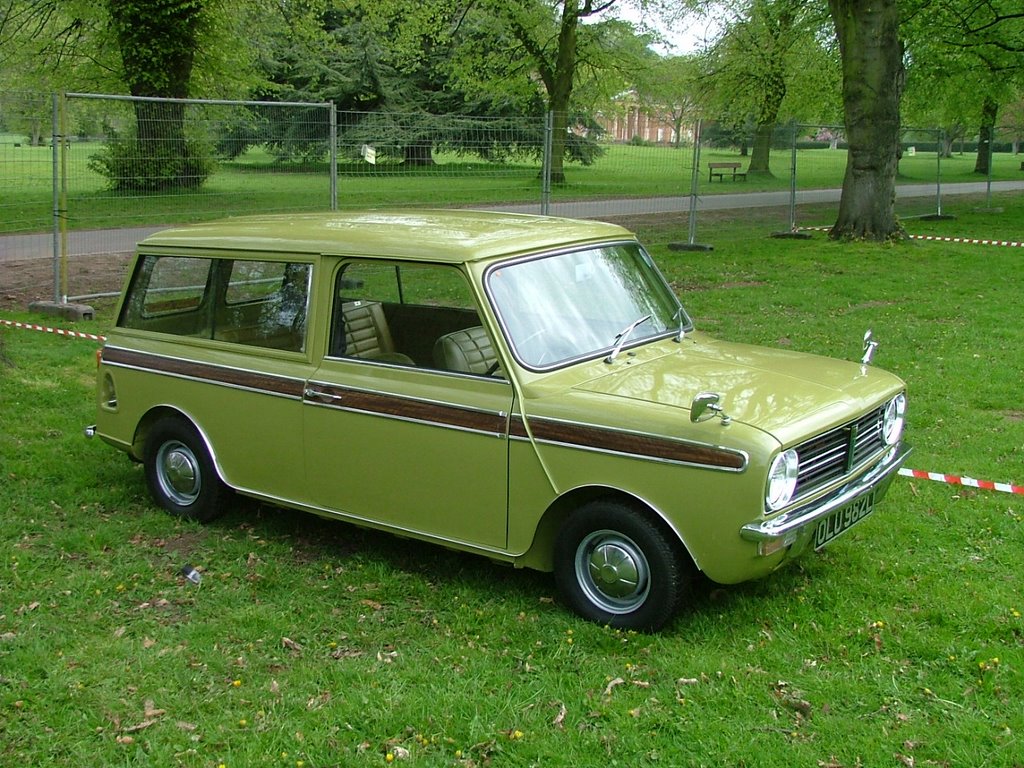
This is Yoda. He's small, green, and - though I hesitate to say 'ugly' - he's a bit wierd looking. For a Mini. He is a 1972 Mini Clubman estate, in Limeflower.
Yoda keeps his complexion by grazing on green green grass.

A few weeks ago, when Liz from the Clubman Estate Register thought the chances of her Clubby passing the audition for Life On Mars* were slipping away, she recommended Yoda to the BBC and, last Friday, Yoda and I made the epic road trip to Rochdale for the filming, in a rather sorry looking disused hospital building.

Yoda on location, somewhere in the vicinity of Rochdale.

They only wanted the cars on set from 4pm, so I was saved the extra hassle of getting up at some unearthly hour, but, on the downside, by the time we got there most of the show's stars had packed up for the weekend and gone down the pub. Without leaving any clue as to which pub. I did, however, have the honour of being the first one to show John Simm the caricatures of the cast in this month's SFX magazine, and persuaded him to sign it (well, he could have taken offence!)
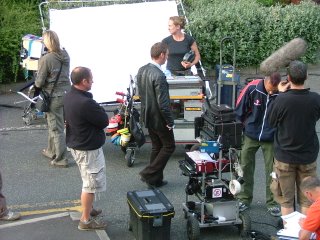
That's John Simm turning his back on me like I'm some sort of crazed paparazzo.

Yoda's scene was an external shot of the Lancashire General Hospital. It lasted about five seconds, but on the plus side, Yoda appeared to have a nice foreground location, so if you don't blink, you won't miss him.

For some reason, Sam Tyler had been barred from the Cortina, and was driving the CID car, which the crew seem to have forgotten was a very similar colour to Yoda. Ooops!
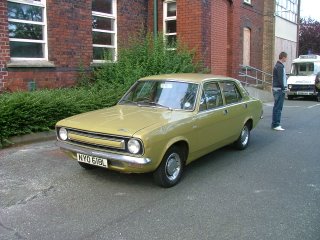
A Morris Marina 1.8 Super. Yesterday.

They even give you a period tax disc, but they don't fill it in, so they pinch it back at the end of filming. Tightwads!

A couple of extras discuss Yoda's early 70s cool. Is she leaning on my car?

Although the drivers of the VW and the ambulance were old hands at this sort of thing and by their own admission a bit blasé about the whole thing, I had never spoken to a TV star in his natural environment before and quite enjoyed the whole thing. Even the sitting around doing nothing, of which there was less than if the vehicles had been needed all day of course.

A Bedford CF Ambulance waits for an emergency to happen.


Can you spot the deliberate mistake?

We did get the chance for a quick snoop around some of the interior sets too; I would probably be in breach of the official secrets act if I published any photos of that though.

I even enjoyed the chance to take Yoda out for a real run. Cars like cars used to be - none of this newfangled nonsense like in car entertainment (like a roaring A-series isn't entertaining enough?) and adjustable seating.

Having said all that, I don't think I'd do it again - not for BBC Manchester, anyway. Nothing wrong with working for them, it's just a long way to go. Now, if Doctor Who were to visit the 1970s... pity I would have missed the chance to meet Billie. Oh well. She'd have probably slunk off to the pub before my sceen anyway...

Yoda will be featuring in Episode 6 of the second series.

*Life on Mars is a cop show with a kind of time travel element, which is how I justify wibbling about it here. For those in foreign climes who may not be aware of it, the basic premise is this: Cop involved in near fatal car accident, while in a coma gets a job as a copper in 1973. We get to watch a cool 70s style cop show while at the same time Sam is figuring out why he's gone back in time and how to get home. That's right; Quantum Leap with a car crash instead of a quantum leap accelerator, and a single leap lasting about 16 episodes. Yes, he's even called Sam.

Friday, August 04, 2006

Out of the Silent Planet by C S Lewis

Since we are here to talk about Christian science fiction, we may as well start at the beginning. Lewis' Cosmic Trilogy must be the first - certainly the best known - overtly Christian sf novel there is. At least, that is how it is most often represented; the Christianity, however, is not particularly overt, although the spirituality is, and knowing CS Lewis it is impossible not to draw out the Christian symbols.

The spirituality of Malacandra tells of a hierarchy of beings: eldila, Oyarsa, Maleldil, and The Old One - angels, archangels, Jesus and God being the Christian parallels. The tale is told of how Earth's Oyarsa fell, caused mischief in Heaven and on the planets, and was imprisoned on Earth.

And so it is that we find wicked Earth men arriving on Malacandra to spread their violent ways, bringing Elwin Ransom as some kind of sacrifice so they can plunder the planet's plentiful supply of gold. Ransom, on the other hand, having escaped his captors and discovered intelligent life on the planet, toys with the idea of being a kind of missionary to the planet... the irony only becoming apparent later on.

Ransom initially encounters, at a distance, the more or less humanoid seroni, who he assumes to be the only intelligent life forms on the planet, and also out to get him. However, it is with a hross that he first manages to make contact, discovering them also to be one of three species of intelligent Martians, the third being the pfifltriggi.

These three races represent three facets of human activity: the seroni are the scientists, the hrossa poets, and the pfifltriggi the builders. All three are untouched by sin, and work together in harmony, acknowledging their differences but none of them claiming superiority. All of which brings us back to the question of what it means to be made in God's image, and what it means to be human.

As science fiction, well, the narrative style doesn't compare to your modern space opera (and at 187 pages, neither does the word count!), reading like a slightly more poetic HG Wells. Lewis embarks on detailed descriptions of the Malacandrian landscape, flora and fauna, as well as the social and spiritual culture of the world he creates. Lewis also takes the unusual step for a sf novel of teaching us the alien language, at least some of the key terms. He manages to pull this off by introducing his protagonist as a philologist, which in itself may be slightly contrived, but makes the whole interaction with Martians feasible.

Of course there are huge flaws in the science, but Mars, and even space travel, seem to be reasonably accurately represented according to the knowledge available in 1938, when it was first published. It still works as a science-fantasy rather than a true science fiction, does some interesting things, and sets the mould for later Christian sf by the likes of Stephen Lawhead and Chris Walley.

Wednesday, August 02, 2006

Countless as the Stars: Chapter One

We're not quite up to normal service yet. As part of the forthcoming refurbishment of my website, the sample chapter is one of the pages scheduled for demolition. So I have painstakingly dismantled it, phrase by phrase, to be reconstructed in it's entirety here in the blogosphere. Where it will find a whole new audience, boost sales and make me a multi-jillionaire. That is how it works, right?

Chapter One

“Eight years ago, Litah single-handedly ended the most barbaric period in the history of Tellus. From Luna Minor, Litah brought salvation to a planet blighted by pollution and decades of war, barely able to support its dwindling population-”
Aidan Qqayle was disturbed from his work as the communal Citycar bounced over the buckled road surface. Glancing out of the window, he could see Luna Minor, a small point of white, pale against the yellow tinted sky of late afternoon, winking as the jagged peaks of ruined tower blocks flashed across his view. The C-car, following a pre-programmed route, was passing through the heart of the old city – a ghost town, abandoned and left to decay when most of Unioncity had been destroyed.
Aidan hit the save button on his comm-cell in case an unexpected jolt wiped out his work, and relaxed, the only sounds the rumbling of tyres on the uneven road beneath him and the occasional popping of his bubblegum. In the near-silence of the C-car he wondered again why Litah was such a burden on his heart.
Aidan believed that Litah – the Link between Tellus and Heaven – was, if not godless, Godless, responsible only to the twin deities on Science and Technology. By their power and his own ingenuity, man sought to dominate God’s universe. Even when the War ended as the Eight Nations united behind the project, Aidan had felt strongly that it was wrong; although so far he had been unable to fully explain this conviction.
The road began to smooth out, the bumps and thumps replaced by a more distant and even rumble as the Citycar approached the eastern edge of Unioncity, where a cluster of small buildings was still in use, mainly farming the fields which lay just beyond.
The C-car coasted noiselessly to a halt outside the last of these anonymous buildings, its sexless, synthesised voice reminding Aidan to take his user card. The kerbside door opened for him as he did so and Aidan stepped out of the orange bubble-shaped vehicle, leaving it ready to be summoned by its next passenger.
“You’re early tonight.”
Aidan looked around for the unseen speaker, and saw Chik Renken at the top of a ladder that reached the roof of the Temple.
“I wanted somewhere quiet to polish up my talk,” Aidan explained. “What are you doing?”
“Replacing the weather vane,” Chik said as he climbed down the ladder. “It’s about time this place started to look like a Temple.”
The building they called the Temple – a name which conjured up grandiose images of marble pillars, elaborate stonework and expensive gold trimmings – was in reality little more than a hut; a smallish building whose breezeblock exterior wore a thin coat of pink gloss in a failed attempt to cheer it up. In front of the building a small car park occasionally harboured the P-cars – private electricars – of the Temple Officials or Followers, and behind it the Temple had a small farm, breeding animals for the sacrifices demanded by the Creed.
“Come on, I’ll show it to you,” Chik said.
Aidan followed him across the empty car park and into the Temple, the pleasant coolness of the interior a welcome change from the heat of the summer sun.
Chik pointed to a heavy looking metal structure on a trestle table in the middle of the hall.
“The two suns,” Aidan said as he approached it.
“Well, I’m glad it’s recognisable.”
Chik had formed the two suns from hemispheres of metal as big as his head, one with small, gently curving rays which reached out protectively towards the blue-green sphere of Tellus, while the sharp, silver coloured rays of the second start tried to skewer the world. This was the second sun which had burnt for a year, its heat destroying life on Tellus, its legacy left for generations after in legend, and becoming a central part of the Creed.
Chik said, “I’ll go put this up, leave you to finish your sermon.”
“It’s too good to put on the roof,” Aidan said as Chik carried his sculpture outside.

Aidan settled down with a large mug of steaming coffee in the study, a small room at the farthest end of the building. He set his comm-cell down, hooking it up to the display screen and keyboard, and started work. The heavy wooden door deadened noise so effectively that Aidan didn’t realise Chik had finished until he walked purposefully into the study, rousing Aidan from his writing.
“Sorry, did I disturb you?”
“No, I was about finished,” Aidan said, without looking up from the screen.
“So what can we expect to be educated on this evening?”
“Litah,” Aidan answered.
Chik lowered his eyes and shook his head. “I thought you’d want to speak about that sooner or later,” he said.
Aidan sat back and looked up at his friend, who was still wearing his scruffy blue overalls.
“I know you’ve got some deeply held opinions on the subject, but…” Chik paused, searching for the right words. “This is a church,” he said finally. “It’s no place for opinions.”
“This is not about opinions,” Aidan argued. “The whole project is an abomination in the eyes of God. The very name is a blasphemy!”
“I know, you’re right,” Chik said. But I’ve known you a long time, Aidan, and I know how outspoken you can be – and I know how strongly you feel about this subject.”
“Chik, I promise you that what I have to say will be nothing if not balanced,” Aidan said. “I will be the first to admit that the project has its good points.”
“Well,” Chik said, “I have to admit, you’ve surprised even me there.”
“Well, the Eight Nations haven’t cooperated on such a big scale in decades – if ever.”
Chik smiled. “Alright,” he said, clapping Aidan warmly on the back. “I’m going to trust you on this. Just don’t let it get personal, OK?”
“Here,” Aidan said, angling the display towards Chik. “I was going to ask you to take a look anyway.”
“Thanks,” he smiled, sitting down in front of the screen.
“I’ve tried to put my personal feelings aside and concentrate on what I believe God thinks of it,” Aidan said. “As my friend, and as an Official of this church, I can’t think of anyone I trust more to tell me if I’ve succeeded.”
Chik didn’t answer. Aidan watched his eyes dance back and forth as he scrolled through the pages of text, and while he was bent over the screen Aidan was pleased to notice Chik’s off-blond hair was finally beginning to thin. Chik was just a fortnight older than Aidan – they had held joint birthday parties since the age of 12 – but now Aidan’s hair was rapidly receding he felt a lot older than his friend. Aidan brushed his hand through his short hair almost unconsciously; he would have to have it shaved again soon, which should even the score a little.
Chik looked up, cutting short Aidan’s moment of satisfaction. “Interesting,” he said.
“Go on…”
“I think you’ve succeeded in hiding your personal aversion to the programme,” Chik continued.
“But?” Aidan knew him well enough to expect a ‘but’.
Chik paused thoughtfully. “But I think some of the phrases you’ve used there are a bit strong,” he said finally.
“Like?” Aidan turned the screen back towards himself.
“Typically human self-centredness, for a start,” Chik said.
“But-”
“There are a lot of humans in this church, Aidan.”
“Don’t you think it’s true?”
“I told you, Aidan,” Chik said softly, “this is no place for opinions.”
Aidan’s opinion was that his best friend – and some of the Followers that had elected him as an Official – was more concerned with keeping people happy than speaking the truth in sermons. That didn’t change their friendship, of course – that had been built over 25 years, since before either of them followed the Creed – but Aidan knew God was much more revolutionary than some of the church leadership felt happy with, and that, Aidan believed, was why Chik was a part of the Temple’s leadership while he was still a Lay Brother, an occasional speaker in the Temple.

After the service, Aidan sat before the sacrificial altar at the back of the Temple, where a small pig roasted on a bed of aromatic plants. Chik had looked disappointed when Aidan used most of the phrases he had tried to discourage earlier, but Aidan made it clear that it was not his own opinion, but God’s, and carefully validated all his arguments. God, wanting nothing more than to see His world at peace again, had allowed Litah to begin, but man had abused God’s gift, as he always has and always will. So God had revealed to Aidan that this plot to conquer and rule creation by human endeavour alone was destined to fail. Not only would it fail though; its failure would be turned to God’s glory instead. God had a way of doing that.
Chik sat down quietly beside Aidan. Aidan didn’t rush, but finished his business with God before taking on the sharp side of the Official’s tongue.
“That was very good,” Chik said when Aidan finally turned to face him. “Thank you.”
Aidan was puzzled. “That’s it?”
“You were right to believe those were God’s views on the subject,” he added. “I see that now.”
“Thanks, friend,” Aidan smiled.
“Sometimes I wonder, you know,” Chik said, “why I was chosen to be an Official above you. I often envy your closeness to God.”
Aidan wondered silently where this was heading.
“But now I know,” he continued.
“Well?” Aidan prompted after a moment’s silence.
“God spoke to me this evening,” he said. “I don’t fully understand the meaning of these words, and you may not either. But God says to you: ‘Leave your country, your people and your household and go to the land I will show you. I will make you into a great nation and I will bless you; I will make your name great, and you will be a blessing. I will bless those who bless you, and whoever curses you I will curse; and all people will be blessed through you.’”
Aidan sat for a moment, struck dumb while he tried to take it in.
“That’s pretty heavy stuff,” he said eventually.
Chik just nodded solemnly. “It’ll be a shame to see you go,” he said.
Those words hit Aidan harder than the prophecy itself. “You really…”
“Yes,” Chik looked him in the eye. “I really believe it.”
Aidan tried to let the word of God settle in his mind, but it all seemed too big, too improbable, almost senseless to Aidan’s tiny human brain, and he couldn’t bring himself to think about it.
“I know how you must feel,” Chik said. “I prayed hard before deciding to tell you; it’s a huge calling, but I wouldn’t be here if I wasn’t convinced of its truth. I can’t imagine how much worse it is knowing the word is for you personally.”
“I don’t know,” Aidan said, getting up and pacing before the altar. “I can’t take it all in.”
“Go home,” Chik said, resting a caring hand on Aidan’s shoulder. “Get some rest and pray about it tomorrow. Talk it over with Savana, and the other Officials if you like, and come and see me when you’ve had a chance to consider it properly.”
Aidan nodded vaguely at his friend, and continued to pace.
“Go on,” Chik said firmly.
Aidan left, reluctantly.
Twilight had arrived, and with it came the cold, but Aidan didn’t feel it as he went to meet Savana. She would have finished work during the service, and gone straight to the Temple farm, where she often tended the animals. The farm buildings lay a short walk from the sacrificial altar, and once the lights from the little pink Temple no longer lit his path, Aidan’s thoughts turned back to Chik’s word of prophecy.
Leave his new home? So soon after they’d settled in? He and Savana were just beginning to make new friends-
“Wait a minute,” Aidan said out loud.
He didn’t like the shape of the thought that was forming in his mind, but couldn’t stop it forming just the same.
He was being pushed out. The Temple Officials didn’t like what he’d had to say, and they were effectively excommunicating him.
“Stars!” he muttered to himself, kicking a stone in anger.

Monday, July 31, 2006

Hello, I'm back.

This is just a short post to ease myself back into things.

In theory I should have plenty to blog about for a while; a couple of book reviews ready to roll, a couple more relevant reads lined up, and I watched most of Serenity before my DVD player packed up the other day (grrrr...)

Some other, not directly related, developments are still going on, and will no doubt be related here when they come to fruition (ooh, tease!).

Big thanks to those on the CSFF blog tour for allowing me to be an honorary participant... typical that I miss the first one with significant sf content!

Obviously I have some catching up to do now, but normal service will resume shortly.

Wednesday, July 19, 2006

'Scuse me, just passing through...

I've been a bit busy lately, with this and that. Playing around with a few changes I want to make to my website, working on a couple of short story ideas, and, when I get a minute, the day job...

To top all of which, I shall be off on a little holiday soon.

If you haven't already found your way their - and are not, in fact, a contributor - Speculative Faith should be able to fill in for me during my absence. And, I expect, way beyond. (Have you fixed my link yet, guys? ;) )

And, because I probably won't get to join in next week, July's Christian SFF blog tour will be plugging the Christian Fandom website on 24-26 July. A good place to start is usually round Becky's place.

I'll be back in August.

This year, all being well.

Monday, July 10, 2006

Doctor, Doctor...

Well, we knew the beeb had a big finish lined up for this season of Doctor Who, but who would have imagined vast armies of Daleks and Cybermen converging on London, for the final of the 2026 Worlds Cup at the recently opened Wembley Stadium?

That the good Doctor would stand in a referee was inevitable as soon as that happened, but surely nobody could have expected the streaker.

I won't spoil it by telling you the score, as I know many of my readers won't get to see it for a while.

If you really want to know how the series ended, I'm sure you can look elsewhere. All I'm saying is, it was possibly a little over the top (in order to top it next year, I hear Quentin Tarantino will be directing the season finale) but Doctor Who fans will certainly enjoy it, with all its entertaining cartoon violence. A bit like the World Cup, really.

Oh, and as we were talking about Ender's Game (well, in passing last week), check this out.

Friday, July 07, 2006

The age old dilemma...

Which Star Wars DVD should I buy? Or should I not even bother?

Do I go for the 4-disc box set, or the forthcoming 'Limited Editions', with the original versions as a bonus?

The box set is cheaper, and has all that bonus material.

The limited editions might be the only opportunity Han gets to shoot first on DVD.

And, of course, it's all subject to the whim of George Lucas, who will no doubt release some other version as soon as these stop making money.

So maybe I should just keep my cash until the super-duper all-singing all-dancing pick-which-bits-you-want-from-each-version box set arrives.

Or just watch them on VHS until the tapes wear out.

Wednesday, July 05, 2006

miscellaneous bloggery 5

The fifth in an occasional series in which I can't be bothered to come up with anything original to write about.

Mirtika reviews Ender's Game by Orson Scott Card;

Orson Scott Card reviews Superman;

Superman reviews In the Open Space (no, actually, I could have that the wrong way round...);

Claw of the Conciliator points us to some discussion on the spiritual significance of Donnie Darko (which I can see I'm going to have to watch again);

phywriter tells us about Ray Gun Revival - something else for me to check out when I'm supposed to be working...

And finally, if anyone can brave an insight into what goes on in my mind besides Christian sf, I've started posting some fairly random stuff on these blogs.

Friday, June 30, 2006

Spiritually Significant Films

I'm not sure how long this list has been knocking around (this is the 2005 edition), but since it's just come to my attention, I thought I'd take a look.

Top scoring sf film is Russian post-apocalypse tale Stalker, directed by Andrei Tarkovsky, who had previously directed Solaris, also on the list.

Sneaking in towards the bottom of the list is 2001: A Space Odyssey, but that's about it for sf. Compare that to the 2004 list, which featured most of the obvious omissions: Blade Runner, The Matrix, the Star Wars trilogy; plus one I had forgotten was about a minister, Signs. Plus this surprise entry, which I seem to remember also had aliens in it. All of which are in my video collection, and will probably get revisited on the blog when I get time to watch them...

The compilers of the list admit to favouring lesser-known movies - which presumably puts Star Wars and The Matrix at an instant disadvantage - but that still seems a poor showing for movie sf, doesn't it? (Having said that, I don't know what I'd knock off the list, other than some of the obscure foreign movies I've never heard of, which is no doubt very unfair.)

I'm almost afraid to do this, but the obvious way to end a post like this is to ask what spiritually significant sf movies have been missed, and open those up for discussion...

Wednesday, June 28, 2006

The future's arrived...

...and it's shrink-wrapped.

Seven colour-coded personality types I can live with.

But choosing a one or three year lifespan? That seems a little, well, wrong somehow.

Well, I mentioned some of the spiritual problems with cloning back here, so I won't digress on the subject now.

I just thought I'd say: Elliot, how'd you fancy one of these for your birthday?

Friday, June 23, 2006

Remember science fiction?

Next week I will meander back towards the subject in hand - that's Christianity in science fiction, in case you had forgotten - but today I can't be bothered, and so as not to spoil the rhythm of 3 posts a week, here's a little light music to keep you entertained.

Wednesday, June 21, 2006

Christian Fantasy Blog Tour: DragonKnight

Under the spotlight this week is Donita Paul's DragonKnight, which, rather handily, came out yesterday. Not having read the book, I have decided instead to discourse on the subject of Dragons:

Many years ago, in a more innnocent time, a new breed was coming into existence. Across the land they emerged, blinking into the sunlight. It was 1982, and they had been shut away in their bedrooms, playing 1K Chess on their ZX81, or marvelling at the colour and sound brought by their new-fangled Spectrums and C-64s. The period of evolution was complete; the Computer Nerd was here.

And it was into the world of the early '80s nerd that the Dragons came. They came from Wales. Port Talbot, in fact, from Dragon Data, of the Mettoy dynasty. First, the Dragon 32, and later, the Dragon 64, swooped on the Sinclair empire, teeth bared, breath flaming, spoiling for a rumble.


You know, as I write this, I'm wondering what on Earth any of it has to do with Christian fantasy. Maybe I should look up this DragonKnight book, see what I can figure out.

*reads amazon listing*

Oh, right. That sort of dragon. Crikey, that's embarrassing. I pictured a geek in a parallel universe searching for retro computers. I'm a bit disappointed, tell you the truth.

Well, erm, since I won't be able to add anything on the subject you can't find out elsewhere on the tour, I'll let this post stand. At least I don't run the risk of duplicating information. Ahem.

The following bloggers may in fact have read the book:
Sally Apokedak
Valerie Comer
Johne Cook
Janey DeMeo
Mary E. DeMuth
Beth Goddard
Rebecca Grabill
Leathel Grody
Katie Hart
Sherrie Hibbs
Marcia Laycock
Shannon McNear
Matt Mikalatos
Rebecca LuElla Miller
Mirtika Schultz
Stuart Stockton

Now, where's that unfinished comic fantasy of mine, I've got a great idea... I think I might call it: DragonQuest.

Monday, June 19, 2006

The Burning: Part Five

Continued from Part Four

It transpired that the probe had suffered little physical damage, beyond some burnt out circuits, presumably from residual radiation, or simply heat. A few components had to be foraged from the bunker's other systems, but a week later, Khem and R'Leef had the probe powered up again, and were ready to send it back up to the surface.
R'Leef nodded at Khem, and placed the probe in the lift. As he pushed the button to close the door, a ball bounced along the corridor at some speed, was deflected by Khem's leg, and bounced off the plastic dome of the probe.
"Oh, heck," said Khem, I hope that hasn't ruined a week's work."
"It'll be fine," R'Leef said, switching on the monitor.
The dingo barged between the two men, almost knocking R'Leef over, and followed his ball into the lift just before the door closed.
Khem groaned, close to despair. "What if the dog breaks it?"
"I would worry more about what your wife's going to say, son."
"About what?" Khem's wife asked. "And what's Ringo doing in the lift?"
Khem looked round, wide-eyed, to see the dog - Ringo - lying down in front of the probe's camera, gnawing contentedly on his ball.
"We tried to stop him," he lied.
"Will he be alright?"
Mercifully Khem was saved from having to answer this when the picture beside him brightened suddenly. He turned in time to see Ringo get up, and bound off into the distance.
R'Leef waited a moment, and once he was sure everything was working correctly, moved the probe forward.
The three of them stood, transfixed by the view. For the first time in over a year, they looked upon the city they had once called home, as it slowly came into view over the hill. The huge towers that stood in the centre raised their heads first, pointing sharply up into the clear blue sky. The vast network of glass and metal that formed the bulk of the city followed, shining in an almost alien sunlight. As the rest of the city came into view, they saw a large area that had been burnt to the ground many months ago.
"Oh no," R'Leef whispered. His own home had once been in the fire damaged zone.
"It';s alright Dad," Khem said. "You can have the biggest house in the city now."
"Thanks," he smiled. "Although I think we should see what other damage has been done first."
The camera zoomed in on the city, its streets - even the highways leading in and out of the city - were still and silent, littered with abandoned vehicles.
"What's that?" Khem pointed at a deep scar running parallel with the highway, from the city out into the wilderness.
R'Leef panned quickly through the city, tracing the cutting's approximate line until he located it on the other side of the city.
Khem's wife had turned ghostly white. "It's the river," she croaked.
They stood in silence, the camera following the dry river bed as it ran out of the city, and into what had once been fertile farmland, but was now dry and cracked, like the river bed. The heat had dried the surface thoroughly, and it hadn't rained in months.
The river ran out of the camera's vision, still dry, so R'Leef focused the camera back on the city. Many of the buildings had sustained considerable damage, very few had unbroken windows, some had had their rooves smashed in or ripped clean off, and others had been decimated by falling debris.
"One day, son," R'Leef said, "all this will be yours."
Khem looked at him, unsure. His wife smirked. R'Leef grinned, and then all three of them burst into laughter so loud and raucous that the rest of the family were soon running along the corridor to see what was so funny.
"The city's in ruins," Khem chuckled, "and the river's bone dry."
"And we lost the dog," his wife giggled.
"But the air's ok," R'Leef laughed. "We made it! We're safe!" and he gave his wife a huge celebratory hug.

A few hours later the lift reached the surface again, this time carrying the eight human survivors of the disaster. All the animals they had with them had been let out into the sun, but for R'Leef and his family, this was their first sunlight, their first fresh air in over a year. After weeks underground with only emergency lighting much of the time, the sunlight was particularly harsh and bright, but the air was incredibly clean and fresh as the last humans alive stepped out onto the world they had to rebuild.
Ringo had found his way back, and lay at the entrance to the lift shaft, panting for water. He slunk into the shade of the lift as soon as Noah's family had vacated it, and lay down again, hot and thirsty.
"So this is all that's left," Uax said.
R'Leef nodded. "This," he said, "and our faith."
"But there's no water," Khem reminded him.
"And it's still so hot!" Zalbeth said.
"Don't be ungrateful," R'Leef said. "We're alive, aren't we? Uax, prepare the sacrifice. We should thank God first. He's given us a fresh start; let's begin on the right foot, shall we?"
And so the hilltop - the very lift shaft by which they had entered this new world - was dedicated to the Lord with the burning of some of the birds they had kept for the sacrifice.
A gentle, refreshing breeze began to blow, and R'Leef thought once again that it carried words to him, although this time the others also appeared to be listening.
"Be fruitful," it said, "increase in number and fill the world. Every living creature which I have saved thorugh you will be under your command. Life is my gift to each of you.
"I now establish my eternal covenant with you, my loyal and faithful servant, and with all of your descendants, and the creatures you watch over. Never again will I destroy the world and mankind in this way. This is my unconditional, eternal promise to you and to all mankind.
"And this is the sign of my covenant with you all - a second moon in the sky. Whenever you see this sign, I will remember my covenant with mankind, never to destroy as I have done now."
The breeze died down, the voice gone as suddenly and strangely as it had come. R'Leef wasn't sure if the others knew, but he was aware that with mankind's sinful tendencies still present in the eight of them, it was possible for things to get that bad again. Reassured by God's promise, demanding nothing of him, he looked at his family, and at the second moon which hung clearly in the bright blue sky. As he looked at this, he saw a cloud form in the distance, growing closer, bigger, blacker by the second. Soon it was on top of them, obscuring the searing sun and the sign of God's covenant, and the rain came down.
Ringo stodd up, and tried to catch raindrops on his tongue. Then his owners tried too, happily getting wet, soaking in the water, sent from heaven to bring life to a world re-born.
R'Leef danced in the rain, singing praises to God, through whose grace the future of mankind was secure.

Friday, June 16, 2006

The painfully obvious Superman post

It seems that since CNN posted this article, the blogosphere has been alive with people commenting on Superman as a Christ figure. The logical thing for a blog about Christianity in science fiction would be to join in, of course.

But, well, until I've seen the film, there's not a lot I can add to the debate.

So instead, pop over to Carmen's thoughts In the open space, and Mir's got some religious superhero links here too.

And while I am, once again, skimping on my responsibilities to write anything original, I recommend these:

More Left Behind bashing: the slacktivist takes a look at the video game.

And I came across this, which I don't think would have worked based on The Phantom Menace.

Wednesday, June 14, 2006

Song of Susannah

Time for another brief diversion into the realms of fantasy, mainly because I want to make a note of something that struck me in this book.

If you're still working your way through the Dark Tower sequence, you may wish to skip this post for fear of spoilers. If you've finished it, don't spoil Volume 7 for me, please!

Back in Wolves of the Calla, we come across Father Callahan, formerly of 'Salem's Lot, who discovers himself to be a fictional character, at least in one parallel universe.

In this book, this idea is carried on to the next level. This kind of self-referential writing could easily have gone either way. In the hands of a lesser writer, or one with a lesser (or less well known) body of work to refer to, it almost certainly would have been the most agonising bit of reading imaginable. If anyone can pull it off, however, it's Stephen King.

And so it is that he has his hero, Roland of Gilead, and his fellow gunslinger Eddie Dean, turn up on his own doorstep. At this point there own suspicions are confirmed - that they too are figments of King's imagination - while King believes himself to be on the edge of a breakdown. This section of the book could be read as an insight into the creative process, or a warning about the perils of alcohol abuse, but the angle that I want to mention here is the meeting of creator and creation.

To all intents and purposes, Eddie and Roland are standing face to face with their creator. You might say, with their god. Roland might say with Gan.

We are back to the idea I mentioned in my last post, that of being forced to confront God as more than just an idea. But in the exchange between King and his creations, we meet a very unwilling god. A god in denial, almost. I don't know what to do with it, but this idea of a reluctant god struck me as interesting, something that may be worth hanging on to for future use. Of course, I'll have to see what Stephen King does with it in The Dark Tower first - I don't think I'll get away with plagiarising him, however inadvertantly!

Monday, June 12, 2006

Doctor Who and the Return to Form

Let me start this post by saying that I was a bit dubious about getting a new Doctor after a single series. Some sort of continuity seemed to be needed so early in the new series.

However, over the last few weeks I have grown quite attached to the new Doc - as has Rose, who, along with her friends and family, have provided that element of continuity. At times David Tennant gives the impression of having grown up watching Tom Baker as the Doctor (I've no idea whether this is the case, but it's quite possible) and has a similar other-wordly quality, manic moments here and there and no apparent desire to take the role at all seriously...

This week was the closing episode of a two-parter - which of course meant the return of the cliffhanger - and a brilliant mix of humour and (relatively) scary moments. If you haven't seen it, skip to the last paragraph to see what ideas it sparked in me.

Spoilers coming!

Hardened Whovians don't bat an eyelid when the TARDIS turns up in a cupboard, of course. And when, on leaving the cupboard, Rose and the Doctor are greeted by the words 'Welcome to Hell', scrawled on a wall it's still business as usual. Until we find that the symbols below those words are a language too ancient even for the TARDIS to translate, which is, apparently, unusual. Even by the Doctor's standards.

They lose the TARDIS, and Rose and the Doctor find themselves talking about settling down and getting a mortgage. It transpires that they have arrived on a planet held in orbit around a black hole. This is, of course, impossible, so Rose and the Doctor join the small team working on the planet, trying to figure out how it is done. The Doctor informs us that to generate a gravity field sufficient to hold the planet in place and provide a safe passage to and from it would need 'a power source with an inverted self extrapolating reflex of 6 to the power of 6 every 6 seconds'.

Which, of course, leads to this particular episode arriving on a blog about Christian science fiction, as we are told that ‘The armies of the beast shall rise from the pit and wage war on God’.

The Beast, in this instance, is in fact the evil of all ancient religions – the face behind the idea, if you like. (I guess it is easier for writers to throw in religion’s bad guys than to comment on the existence or otherwise of god, maybe because it is easier to accept the existence of an evil force than that of an omnipotent creator.)

Apart from the obvious references to the devil and its religious implications, there were a few other interesting pseudo-religious points of note in these episodes. Firstly, this is the first time in the new series that the Doctor had acknowledged an adversary as being actually evil. More importantly, the Doctor (naturally) takes it upon himself to destroy the Beast and save the universe. However, in order to consign the Beast to the eternal pit of the black hole, the Doctor must sacrifice himself and the inhabitants of the impossible planet to that same fate. Most importantly, in order to defeat Satan, the Doctor must allow Rose to die – he himself must set in motion the chain of events which will lead to their deaths.

End of Spoilers!

What intrigued me, as a writer, was the idea that Satan – in all his many guises – could be an idea, a kind of racial memory based on an actual entity who lived an unimaginably long time ago. The idea occurred to me of turning the idea on its head somewhat: What if it was God who had been consigned to racial memory? What if, in some impossibly far-future world, someone was to happen across ancient Christian writings? What if ‘God’ is nothing more than an idea, a philosophical talking point, until something brings these enlightened 42nd Century beings into contact with the reality of Him?

Friday, June 09, 2006

General Ignorance

Those few links in my last non-fiction post (and here's another for good measure) have highlighted one thing: it appears to be a widely held view that there is very little Christian science fiction available, or that the genre begins and ends with the esteemed Mr Lewis.

If you've been here a few times - and especially if you've checked out the Elliot List - you will know that this is not necessarily the case. However, I think this depends a great deal on your interpretation of what 'Christian fiction' actually means. I had a stab here, and there's a reasonable list of Christian elements here.

Until I began looking a little harder, started this little blog, and encountered the Elliot List, I was guilty of the same kind of ignorance. I had discovered Stephen Lawhead, Chris Walley, and of course CS Lewis - all in Christian bookshops - but was largely ignorant of what Christian elements may exist in secular sf novels. Only a further reading of some of these stories will tell whether (IMHO) they cut it as 'Christian' novels. I suspect that if an author is writing from a Christian worldview, and including an element of spirituality in their tale, the Christian element will be visible to those looking for it.

It is, of course, possible to portray Christianity in a negative light (as in His Dark Materials), or as an integral story element without actually adding anything to the reader's faith (Snow Crash, reviewd here recently, has an integral religious thread, but I would never consider it a Christian novel).

My best guess is that if people want Christian fiction to challenge them and make them grow in their faith, they may be largely restricted to what's in the Christian bookstores (although there will always be exceptions picked up by mainstream publishers) and as far as sf goes, that's a pretty limited choice.

The question is, What do we hope to gain from reading a Christian novel?

I'll leave that one open to the blogosphere.

Wednesday, June 07, 2006

The Burning: Part Four

Continued from Part Three

Down in the city, the casino finally opened. Wine, beer and spirits flowed freely. Most of the people from the city turned up, along with many from neighbouring towns, despite the unusually strong, hot wind that made travel difficult. These travellers wondered briefly about the small cluster of trucks abandoned at the top of a large hill, but soon forgot as they enjoyed their games of roulette and blackjack.
As the wind built up, the empty trucks on the hillside were overturned, and sent rolling down the slope, leaving a trail of broken glass and debris as they fell, finally crashing violently to a halt in a densely populated suburb, where the fuel tanks erupted noisily into a fire which was spread rapidly by the hot wind.

For forty days the winds crushed plants and animals, the breath of life replaced with the burning hot wind of a supernova. The dust and grit which rained from the sky grew hotter and larger, boiling lakes and rivers, smashing doors and windows, leaving no hiding place for the people of Tellus. After forty days the dust settled, but the heat and radiation remained.

Inside the bunker, everything seemed to be going well while they were counting off the days. By the time it had become easier to count the weeks, and counting the months had been seriously considered, the occupants were frightened, bored, and tense.
“Your god’s forgotten us, hasn’t he?” Khem challenged angrily.
R’Leef merely looked up wearily.
“Hasn’t he?”
Khem’s mother put a hand on his shoulder in an attempt to calm him. He glared at her, the light from the fluorescent strips above him glinting menacingly in his eyes. She shrank back slightly, withdrawing her hand.
“Sorry, ma,” Khem said, reaching out to take her hand.
She smiled up at him.
“No, you’re right,” Zalbeth said. “We’ve been abandoned. How long do you suppose it takes a god to destroy the world? It only took him a week to make it!”
R’Leef stood up, struggling to keep his patience. “Don’t you think I’m scared too? He asked. “Don’t you suppose I get bored down here? Lonely?” R’Leef looked from one to the other. “Well?”
After a brief pause, Khem spoke. “It’s your fault!” he cried. “It was your stupid idea! You locked us all in this dungeon! You and your so-called god!”
Then the bunker, heavily insulated as it was, trembled violently. Tables shook, cupboards fell over. There was a loud rumbling sound, punctuated by the noise of plates and bottles smashing. The lights went out. One of the women screamed.
Khem looked around, waiting for his eyes to adjust, but they never would. With no windows and all the exits tightly sealed, the darkness was complete.
There was another rumbling sound, muffling the noises of frightened animals above him. Fear took over Khem, and he sank to the floor, and wept.
“I’m sorry,” he sobbed. “Sorry, dad. Sorry, God. Please put the lights on! Please!”
A single circle of light danced on the floor in front of him. Khem’s tears of fear became tears of relief, and he began to laugh nervously.
“Get a grip, Khem,” Uax said.
Khem looked towards his brother, silhouetted behind the torch beam.
“It’s just the animals getting upset,” Uax continued. “Come on, we need to get the back-up power running.”
Khem looked at him, feeling worried and slightly foolish, and nodded. He started to get up just as an aftershock struck; he stumbled, clutching wildly at the nearest person for support. R’Leef grabbed his hand and helped him to his feet.
“Thanks,” Khem said, sheepishly.
“You’re welcome.”
“Sorry,” he added.
R’Leef nodded at him. “Can we get enough power from the back-up?”
“Not as much.”
“Will it keep the crops growing?”
“To give the same amount of power to the crops will mean having emergency power only down here.”
“What about the animals?” Zalbeth asked.
“Same thing, I think,” Khem said. “And we might have to lose the freezer.”
“That should be ok,” she said. “If we keep it closed it should stay cold enough – depending how long we spend in here, of course.”
“Do what you can,” R’Leef told Khem. “Keep the livestock happy and the plants growing. We can manage on emergency power and candles.”
Khem nodded.
“Have faith, everyone,” R’Leef said. “God was with us when we started this little adventure, and there’s no reason he should abandon us now.”
“I believe you,” Uax said.
The others nodded in agreement.

Keeping their little world within the world running smoothly on emergency power kept the bunker’s occupants busy over the following weeks, but the cold and dark soon wore them all down again.
“How much longer do we have to sit down here in the dark?” Khem was first to voice their frustrations.
R’Leef didn’t want to be in the bunker longer than necessary, and he certainly didn’t want another argument with Khem.
“I think we can afford to take a little peek,” he smiled.
R’Leef put down the book he had been reading and went with Khem to the far end of the bunker.
“What are we doing?” Khem asked.
R’Leef keyed a code into a small panel beside one of the generators. The panel slid open, and he pulled out a small plastic dome, beneath which Khem saw small wheels and some electronic circuitry.
“A probe,” R’Leef explained. “It’s radio controlled; I’ll control it from here, and we can see the world outside on the monitor.”
He opened the lift doors, and sat the small probe inside it. Khem switched the lift to exit, and they both turned to the monitor behind them. The view faded in – the lift doors. After a few seconds the doors slid open, and R’Leef moved the probe out of the lift shaft. At least, he tried to, but before it had moved more than a few centimetres the view on the monitor crackled, and died.
“Damn,” Khem whispered.
R’Leef sighed. “Bring it down,” he said.


Concluded in Part Five

Monday, June 05, 2006

Miscellaneous Bloggery 4

The fourth in an occasional series in which I can't be bothered to come up with anything original to write about.

Following my Snow Crash review, Elliot has drawn attention to this post about the author by Theocoid.

Madame Mirathon posted some SF/F stuff to sweeten our Sundays; I expect any day will do though. :)

And during a moment of random having-nothing-better-to-do, I came across this discussion of science fiction & supernaturalism, and this slightly older blog on Christianity and science fiction, and this slightly negative view of the subject from Think Christian a while back.

Friday, June 02, 2006

A post of random comments

I'm in a bit of a sci-fi drought at the moment. Earlier in the year my Sunday afternoons consisted of Enterprise and Stargate:SG-1. Now I have to do things like 'go out', and 'enjoy the fresh air'. Then some joker at Channel 5 (sorry, five) thought it would be a good idea to show Voyager re-runs on weekday afternoons. I could have lost my job over that!

Now there's just my weekly dose of Doctor Who in the way of sf TV, and last week's episode stretched its science fiction credibility to breaking point (TVs that suck your face off, anybody?). That said, it was great as 'scary but fun family entertainment', which is a large part of the show, but I'm hoping for more from the Ood this week.

Maybe all this is exacerbated by the fact that I've just come through the fertile pastures of Firefly, that rare entity: a TV science fiction show which dares to entertain the existence of God - and, indeed, Christianity - even in the outlying regions of a galactic human civilisation. All at the same time as being top notch telly. This was the first time I had seen of most of the episodes, and most of the time I was too busy being swept along by the action, the humour, and the fact that Joss Whedon was trying to do something new with the sf genre, to pay that much attention to Shepherd Book and what (if any) kind of Christian he was. Serenity, naturally, waits patiently on the DVD shelf for a free evening.

Even my reading has taken a dive towards fantasy lately, but James Blish is calling, just as soon as I've done with Volume 6 of Stephen King's Dark Tower opus.

Wednesday, May 31, 2006

A short sharp blog

For those that may have missed it, here is Elliot's take on one of my favourite Christian novels, Dream Thief. He wasn't quite so enthusiastic...

Case of Conscience is next on my reading list; Pug has just finished with it, you can read his thoughts here.

And the latest part of the ever entertaining dissection of Left Behind is here.

Tuesday, May 30, 2006

Countless as the Sequel

It doesn't have a title yet, but 'The Sequel', as it is called in my head, is beginning to take shape. There will be elements of Bible stories in there, but rather than just re-telling them (as with Countless as the Stars) they are just part of the story, which will be much more along the lines of a regular space opera. And that means I can leave in the sex, drugs and violence without scaring off the Christian market I originally wrote it for...

Watering down the Biblical basis was something I deliberately avoided with Countless, intending it for a Christian fiction market which fell flat on its face in the UK. As a result, some of the sf elements were watered down, probably to the detriment of the story. Although the sequel will follow on from the events of Countless, I plan to make it a standalone story, hopefully worthy of the wider sf market. Unfortunately for my loyal readership, that will probably entail recounting some of the key events in flashback, but I guess we'll wait and see what my publisher says... ;)

Anyway, here's a quick teaser:
Twenty years have passed since the expulsion from Tellus.

Despite many difficulties, the United Colonies are thriving.

Aidan Qqayle, reluctant leader of the UC, hasn't seen his father since they settled on Lomas, shortly after the old man died.

Now he's back, with one more task for his son to complete. A task that will lead Aidan to confront his past, doubt his present and, one way or another, influence the future of the entire system...

Wednesday, May 24, 2006

The Burning: Part Three

Continued from Part Two

The bunker was dug into a hill overlooking the city, which looked like a huge siler jellyfish, stranded on the vast sandy plain, the highways leading out of it like tentacles. Uax and Khem had worked almost non-stop for three weeks rendering the disused bunker inhabitable, using the plans drawn up by R'Leef.
The main entrance was through a well camoflaged door forged out of heavy steel, which led past a lift shaft running between the bunker's three storeys, and extended back into the hill. At it's far end, another, much smaller, steel door opened out onto the hillside.
R'Leef sat beside the main entrance, watching a convoy of hired trucks making their way slowly up the steep hillside. Power generators, plants, freezers, furniture - all were on the way to the bunker as it neared completion.
R'Leef knew what he had to do. God had been warning mankind of his judgement; only R'Leef and his family had listened. Once they were ready, God would bring his judgement.
One more week, he prayed, nervously. That should be enough.
Something cold and wet nudged R'Leef; he jumped, then relaxed, seeing the face of a friendly dingo behind him.
"Yes, this is the place," he said, stroking the dingo lightly. He stood up to lead the animal to Zalbeth's temporary surgery. Only when he turned did he see the full extent of what God was doing here.
The plain below him was alive, as creatures of all sizes moved across it, faster animals running in from the horizon, overtaking the closer, slower animals. Even as he watched, herds of animals appeared from other directions, all converging on one point, a large tent at the foot of the hills.
"Zalbeth," R'Leef spoke softly into his two-way radio. "I hope you're ready for action."

The next seven days were filled with activity; extracting, labelling and storing DNA samples, preparing a greenery, and putting the finishing touches to the living quarters.
The upper floor was taken up entirely by the greenery, divided up to provide the optimum amount of heat and light for the huge variety of fruit, vegetables and other plants.
The middle floor was set aide for the animals they would be taking with them - some they would need for food, others were needed as offerings to God. A small kennel had recently been added under the stairs, where the dingo and its mate slept. Several birds flitted around the dimly lit room.
The bottom level consisted of six bedrooms, the living and recreation rooms, a kitchen and dining area, and a walk in freezer packed with DNA samples. Near the lift shaft, Khem had set up a reserve power generator - he had installed and powered up the main generator as soon as he could, but couldn't take the chance on it lasting indefinitely. They had no idea how long they would need to stay below ground.

Once the bunker was furnished and habitable, all the animals saved for future generations, and R'Leef had done all that the Lord had asked of him, the eight of them entered the bunker, where they would be kept safe from the wrath of God. R'Leef watched as his family went in, a hot wind building up behind them, swirling, directionless, so full of dust that at times it obscured the sun. One of the heavy trucks they had hired for the move rocked in a strong gust. R'Leef felt a pang of guilt; he had every intention of returning it, but time had run away from him.
It doesn't matter now, he felt God whisper.
He smiled, raising an arm to protect his face from the hot dust blowing into it.
"It's starting," he said to Uax, the last to enter the bunker. "Go on in. I'll follow in a moment."
Uax turned briefly to his father and nodded, unable to make himself heard above the howling wind.
With the last of his family safely inside, R'Leef took one last look out over the city, through eyes half-closed against the dust-laden wind.
His eyes widened, and his jaw dropped, suddenly oblivious to the flying grit, when he realised he was looking at the full awesome power of God being used in anger. High above the city, still as visible through the dust clouds and the sun, a new star glowed a deep red-orange.
For a moment, R'Leef even thought he could see the huge waves of energy this exploding star was sending out, and which were just beginning to reach Tellus, when he was knocked backwards by a sweeping gust of warmth, hot dust stinging his face, the wind taking his breath away.
He stumbled backwards into the tunnel, where he was caught by Uax.
"Are you alright?" he asked.
R'Leef was staring, wide-eyed, out of the metal hatch at the plumes of sand and dust that whistled across the entrance to the bunker.
"Yes," he whispered, nodding weakly.
A sudden change in wind direction slammed the hatch closed with a bang that echoed through the narrow passage for a second, and rang in R'Leef's ears for much longer. He looked up at Uax, who confirmed that the hatch was locked.
The Lord had closed the door behind him, and had locked them in.


Continues here

Monday, May 22, 2006

Alternative Jesus: The Second Coming

Now the problem with bringing Jesus to life in the 20th Century, as suggested in my last post on the subject, is that the 20th Century as we know it would not exist had he not walked the Earth when he did. As has been speculated elsewhere, the Roman Empire may have continued to flourish. The influence on Christianity throughout western culture would have to be carefully removed from every aspect. There would have to be some alternative means of working out what year it is, which is one thing that really bugged me about Roma Eterna.

Is it possible to get from 33AD to 1933 and still end up with Hitler's rise to power without the effect of Christianity? Possibly, or at least something similar; but if not, there is always an alternative - Left Behind: the WWII chronicles!

Alternative histories of World War Two are so much a staple of sf as to be a cliche unless given a sufficient twist. Harry Turtledove continues to be a prolific writer of alternate WW2 scenarios, notably the Worldwar sequence, in which an alien invasion interrupts the proceedings... (Incidentally, I think these stories, in trying to follow the course of events in the US, Japan, Germany and Russia, as well as on the alien mothership, get a bit too complex to keep track of at times, and I had trouble figuring out why the lizards wanted to invade anyway if all they were going to do was moan about the weather.)

So that's my latest plan to sneak in under the cover of 'end times thriller' and introduce sf to the Christian fiction reading masses.

Although, Elliot's probably read it already...

Friday, May 19, 2006

Christian (Science) Fiction Review

If you've been following the Christian Fantasy Blog Tour, you'll know that a bunch of bloggers have been talking about Tim Frankovich's Focus on Christian Fantasy. Well, for my part, I've perused his Christian Fiction Review website, and have found the following reviews of books crossing the line into the worlds of science fiction:

Nancy Moser's Second Time Around, sequel to Time Lottery, uses the sf device of time travel, but doesn't appear to concern itself too much with the science (often the best way with time travel).
Time travel is also used in Randall Ingermanson's Premonition and Retribution, again with the science less important than the actual story.
Ingermanson, along with John B Olson, gets more into science fiction with Oxygen and its sequel The Fifth Man, near future thrillers set on Mars missions.

Another near future story, A Form of Godliness by Shane Johnson, is reviewed as a contemporary thriller rather than sf, but its near future setting qualifies it for the genre in the broadest sense.

Another Johnson novel, The Last Guardian, "culls elements of fantasy, science fiction, horror, and ethical parables" according to Tim's review, and mixes in elements of the 'end times' novel.

Similarly straddling the line between sf and fantasy is Outriders by Kathryn Mackel, a kind of post-apocalyptic science-fantasy.

Shivering World, by Star Wars novelist Kathy Tyers, is proper science fiction - hard sf with a spiritual twist - with other planets, terraforming, genetic engineering, and even, apparently, actual science...

The Traveler by Peter Krausche is promised to be the first in a seven book time & world travelling epic.

And finally, Tim looks at Sky Songs 1 & 2, two short story collections containing a mix of sf and fantasy.

I have to confess I haven't read any of these, but some of these participants in the blog tour may have done:
Becky Miller's Christian Worldview of Fiction
Mirtika Schultz’s Mirathon
Insights from Beth Goddard
Jason Joyner’s Spoiled for the Ordinary
Marci’s Writer Lee
Sally Apokedak’s All About Children’s Books
Cheryl Russell’s Unseen Worlds
LaShaunda’s See You On The Net
Shannon McNear’s Shenandoah’s Eclectic Musings
Meg Mosley’s Megawriter
Stuart Stockton’s The Jerkrenak’s Den
Sharon Hinck’s blog
Valerie’s In My Little World
Karen Hancock’s Writing from the Edge
Chris Well: Learning Curve blog

Wednesday, May 17, 2006

Aternative Jesus 3

This subject started out as a little rant about the Wossname Code, then veered off a little more towards alternate history, and along the way got picked up by Elliot and Catholic Steve...

And now I realise that I hadn't quite finished with it myself.

Before you reach for the stones again, what if, instead of taking Christ out of the equation entirely, we just moved him about the timeline a little. You know, have him actually face the kind of dilemmas modern life insists on presenting us with.

It doesn't have to be today, of course; if it was, it would certainly be a different today - the way the world would have turned out without the influence of Christianity. It could be the near future, a space-faring future (for those of us aching to write a Christian space opera) or the year 5 billion.

Or venture into the past - have Jesus walk the earth in 1960s London, or '80s New York, or transplant him into any of the What ifs I mentioned in my first post on the subject.

I've been looking for a unique hook for my WW2 alternate history...

Tuesday, May 16, 2006

The Christian Fantasy Blog Tour

OK, I know I said I was going to get back to sf today, but I'm short of time today, and having grabbed onto the coat tails of the aforementioned Blog Tour with the idea of adding some science fiction into the mix, I'll just have to settle for directing you to some of the other participants:

Mirtika Schultz’s Mirathon blog
Insights from Beth Goddard
Jason Joyner’s Spoiled for the Ordinary
Marci’s Writer Lee
Sally Apokedak’s All About Children’s Books
Cheryl Russell’s Unseen Worlds
LaShaunda’s See You On The Net
Shannon McNear’s Shenandoah’s Eclectic Musings
Becky Miller - A Christian Worldview of Fiction
Stuart Stockton - The Jerkrenak's Den
Jim Black

I'll be back tomorrow with, hopefully, something more to contribute!

Monday, May 15, 2006

Miscellaneous Bloggery 3

A few things have caught my eye during the weekend's surfing, so here are some highlights that may appeal:

More comment on that Da Vinci thing, from Caritas and Johnny Dangerous.

Half of the new Entropy Gate website is up: check out the website and the blog.

Becky Miller has finished discussing theme, and is off on the subject of 'Fanatsy and a Christian Worldview'. I shall be watching carefully, if only to pilfer ideas for this blog... ;)

Becky will also be participating in a Christian fantasy related blog tour, which you can find out a bit more about at Beth Goddard's blog, and which kicks off with this feature at Christian Fiction Review.

Tomorrow we'll get back to science fiction. Probably.

Friday, May 12, 2006

The Burning: Part Two

Link to Part One

"I just don't drink, OK?" Khem insisted.
He was in a pub near the site of the new casino, where he was senior electrician, trying to persuade a burly bricklayer to order him a lemonade.
"Take after that looney-tune father of yours, that's your problem!" the brickie laughed.
"He's not a looney!"Khem shouted, lunging for him.
The rest of the crowd cheered as Khem wrestled the big man to the floor - all of them, including Khem, if he thought about it, knew the bricklayer was putting it on, and would be able to get up just as soon as he chose.
"Khem!"
The crowd of builders looked to the door, where the old man stood with a young woman in a white coat.
"They're coming to take you away, too!" one of them quipped.
The brickie loosened his grip on Khem, who stood up, blushing slightly.
"Hello, Dad," he said quietly.
"I think you'd better come with us," Zalbeth said.
Khem brushed past them silently, and hurried out of the car park, not stopping at his father's people carrier. He was still angry when his father drew up alongside him and offered him a lift.
"I'd rather you drank than built casinos and started bar brawls, Khem," R'Leef said patiently.
"Didn't start it," Khem muttered.
"Well, it doesn't matter now," R'Leef said. "You'll not be doing either for much longer."
"You can't stop me from working there, old man."
"I don't intend to. But unless you change your ways and listen to me, God will judge you along with the rest of humanity."
"OK, OK." Khem held up his hands in protest. "I've tried to go along with your religious stuff; I've given up drink, I've said my prayers every night - what more do you want?"
"Just listen to him," Zalbeth said. "He's trying to save your butt."

Having persuaded Khem to help him, R'Leef had a slightly easier job in getting his eldest son, Uax, to cut short his latest voyage - although he did have one objection.
"But I'm on my honeymoon, man!"
"Your wife is welcome, of course," R'Leef smiled into the video-phone, "as long as she does her share of the work."
"How long?"
"God will wait until we are all safe," R'Leef told him. "But don't let's keep him too long," he added hastily.
"We'll be there as soon as we can," Uax said.
"See you soon," R'Leef nodded, and switched of the phone.

A few days later, R'Leef was chairing a family meeting in the family's modest semi on the edge of the city. Since Uax and Zalbeth were both married, Khem had been permitted to bring his girlfriend along too. The others had been unenthusiastic about this initially, but she had promised to be faithful and obedient to Noah and to God - and so far had been a better worker than Khem himself.
"The bunker is in the desert," R'Leef explained. "Khem will be in charge there-"
Khem looked up suddenly - his name had never been used in the same sentence as the words 'in charge' before.
"Because he's the only one with any knowledge of construction work," R'Leef added.
"Thanks," Khem smiled.
"I have some rough plans to share with you later. We will also have responsibility for the animals - this is where Zalbeth comes in."
"What do you want us to do?" It was her husband who replied.

"The animals will all come to us to be kept alive - how you do that is up to you, but we owe it to God to preserve as much of his creation as we can."
Zalbeth nodded thoughtfully, and then said, "How much equipment can I take from my lab?"
"You may not need much. The bunker used to be a research lab - it's likely the Lord has provided all you need."
"If God is going to provide the animals," Zalbeth said, as much to herself as to her father, "then theoretically if I could take a DNA sample from each and keep it safe, that would be enough."
"Can you repopulatethe world from a few blood samples?" Khem asked.
"With the right equipment," Zalbeth nodded. "But that's the difficult part."
"The Lord promised to provide for the future," R'Leef said. "Although he will wipe out everything living on the planet, the city - civilisation - will remain for us to inhabit later. Your lab - and any other - will be available for creating your clones later. If the technology exists, we can find it later."
"Are you sure?"
"Have faith. Speaking of which, we will need to keep some animals for food and sacrifices; if Zalbeth's plan will work, these will be the only livestock to enter the bunker with us. Someone will need to take responsibility for them."
"Cool!" Khem's girlfriend spoke up. "I love animals!"
"Don't get too attached," Khem said. "They're our lunch."
"I know."
"Then you've got the job," R'Leef smiled. "On the subject of food, my wife and I have some experience of growing fruit, herbs and so on, and will see to this in the bunker. I must also spend time with God - we all must - and I will set aside time to pray for each of us. I would ask one of you, therefore, to help when I am otherwise occupied."
"I will do that," Uax's wife volunteered.
"What about me?" Uax said.
"As my eldest son, you will be my deputy. Oversee everything; help wherever you're needed."
R'Leef looked around the table, seven pairs of eyes firmly fixed on him. "Any questions?"
They all shook their heads.
"Then let's not keep God waiting any longer," he said. "You know what you have to do."
Six of them left the table.
"I take it you wanted to see those plans?" R'Leef asked Khem once they were alone.
"Yeah," he answered, "but there was something else..."
"What's that?"
Khem looked carefully at a small scratch on the table in front of him. Took a deep breath. Looked his father in the eye. "Sorry I doubted you," he said, and looked quickly back at the table.
"That's history now," the old man said, resting a hand on his son's shoulder.
Khem smiled up at him, a smile he hadn't seen since Khem was five or six, amazed by his Dad's talent with superglue...
"Come on," R'Leef said. "We've got work to do."

Continues here

Thursday, May 11, 2006

Stones it is then.

Seems like my What if's didn't go down too well...

Speculative Catholic was kind enough to steal - er, I mean, reproduce ;) - part of my post, attracting a 'thanks but no thanks' kind of reaction...

I'm not sure what to make of the silence here - maybe I've scared everyone off with the merest thought of such heresy! Well, you can all come back, I'm not about to do that just yet. Although I do find the idea interesting.

The first question that occurred to me after 'What if Christ had not been crucified?' was 'Would the Roman Empire have fallen?'

Robert Silverberg explores this possibility in Roma Eterna, but from the perspective of Christ never having been born; he supposes that the Exodus failed, leaving the Hebrews a barely noticed minority among whom a great prophet never rose, and never started Christianity.

And you don't see anyone throwing bricks at him, do you? I guess it must be safer to just take Christ out of the equation than to wonder what he might have done differently.

I'm just thinking aloud here, please ignore me if I continue to offend. :)

Tuesday, May 09, 2006

The Da Vinci Bandwagon

OK, I know this is a little off topic, but bear with me.

I'm sure you will have noticed a little bit of publicity about a little movie based on a little book called the Da Vinci something or other. Reading a conversation about the subject in the Blogosphere recently made me think: Maybe I should read it, find out what it says that's got so many people so wound up. Of course, I've heard a lot about it, and opinions vary hugely; writers, English teachers - people I trust to know about this sort of thing - say it's not very well written. A number of people - many of them Christians - have said it's a good read, provided you don't forget it's just a story. Another group of Christians seems to be getting very uptight about the very existence of the book and the film, many, I suspect, without having bothered with basic research such as, oh, reading the book, for instance. And the TV people? Well, the documentaries treating 'the conspiracy theory' as something with a solid foundation in reality have just been feeding the insane paranoia that says this is a true story...

I haven't read the book. Don't plan to, or to see the film. Not because I object on some moral or religious grounds, I just can't be bothered. I therefore have no opinion on the content of the book. So why am I adding to the already huge volume of hype surrounding it?

Well, fiction is about playing 'What if...?'. This is most obviously the case, perhaps, in science fiction, particularly that sub-genre known as Alternate History:

What if the Cold War had escalated?

What if Germany had won the Second World War? Or the First?

What if the British Empire existed today? What about the Roman Empire?

It doesn't have to be about war and conquest, of course, but they are obvious turning points in history and ripe to be altered. I could just as easily ask what if the Beatles had never split up, or never formed in the first place?

And whichever way you approach it, there can be few events in human history more pivotal than the life of Christ. So why not ask 'What if'?

What if Christ escaped crucifixion?

What if he had never been born?

What if he had raised a family? What if he did have a blood relative alive today?

The Wossname Code may not be an alternate history as such, but is there any reason these questions should not be raised in sf? Could a Christian writer tackle these questions in a sympathetic manner? And more importantly, would Christian readers take him seriously, or would they be hunting him down with a bag full of large, pointy bricks?

Monday, May 08, 2006

A word on End Times 'Thrillers'

Rubbish.

What, you want more than a word? Well, OK, but I don't think they deserve it. The only reason I mention them at all is to point you to this blog, which runs an occasional series plotholing the Left Behind series.

But while I'm on the subject, I may as well get my rant over, since Left Behind and all the other 'End Times Thrillers' that followed in its wake can be included in the broad definition of science fiction, in that they are set in the not too distant future. But having read the original LB series (I know, what was I thinking?) and been utterly underwhelmed, I don't intend to give this sub-genre a regular spot in the blog. At least until someone writes a decent one.

I commented on my other blog that, even recognising that I'm still an amateur at the writing game, I could have written the LB series better. I came up with the idea when I was about 14, just before the Cold War ended, but didn't have the Bible knowledge to do anything with it. Heck, I probably could have written it better then...

Tyndale House have, thus far, declined my offer to write Left Behind: London, presumably in case I do in fact turn out to be much better than LaHaye & Jenkins...

Anyway, enough of this speculation.

In the hope that LB had in fact spawned a sub-genre now packed with decently written Apocalypse stories with a Christian twist, I grabbed Wired by Robert L Wise from the library a while back. That was nearly as bad.

Well, maybe I'm being a bit harsh. The plot was predictably similar to that of the LB series, which gave the whole book an instant disadvantage, but the quality of writing didn't do much to counter that. And then there was the odd phrase that caused me to chuckle. Take, for instance, our introduction to the post-Rapture Christians:

"They are more of an underground group."
"Really!" Matthew grinned. "Now that really gets my attention. What are they called?"
"New Seekers." Jennifer lowered her voice.
"Awesome. I like the sound of the name."
The New Seekers? I mean, for goodness sake, the rapture's just happened, and you want to buy the world a flippin' Coke?

And, just like in LB, spiritual enlightenment is provided by a Jewish Bible scholar who just happened to be passing, in this case, former adult film star* Adah Honi. Who, annoyingly, talks like Yoda:

"The important issue is what says the Bible."

"Perhaps, we simply have not figured out for what idea the number is a symbol."

"Let us quickly walk away from the platform. We need from any cameras to stay away."

"One of the next steps in the Anti-Christ's plan is new believers to persecute."

I won't be following that series until the Glorious Appearing. Which, incidentally, I thought might put a stop to LaHaye and Jenkins in their quest for world domination, but, like George Lucas before them, they have discovered the prequel. The latest of which, apparently, will be launched on 06.06.06.

I've just realised. LaHaye and Jenkins are the anti-Christ!


*OK, I may have added that bit myself.


Wednesday, May 03, 2006

Androids have rights too, you know.

Since I seem to have strayed into artificial intelligence over the last couple of posts, it seems fitting to comment on this item, conveniently posted yesterday.

The author, David Levy, believes that 'within about fifty years there will be almost no limit to the intellectual and creative powers of robots, nor to the sophistication of their electronics and their electromechanical design.' Fifty years is a long time in technology, so he may well be right. But there are more theories presented in this interview which, although pretty far out for actual scientific prediction, make good sf fodder. For instance:
ChessBase: Are you really so sure of your predictions about love, marriage, sex and reproduction with robots? Isn’t this all rather science fiction?
Levy: No, it isn’t science fiction.
Reproduction - why not? Self-replicating nanobots have been an accepted sf device for a while, after all. When you think, as Levy appears to have done, about human-robot relationships, however, I start to shudder. He does, however, make a valid point about same-sex marriages; who'd have thought that would happen, even fifty years ago?

Most interestingly, Levy also speculates on robot rights (which I think led to the world of the Matrix), robot ethics, and even robot religion...

I'm sure some of this has been covered in sf - Asimov's robot stories spring to mind, as does Star Trek's Data; robot religion specifically in The Quest for Saint Aquin (Anthony Boucher), and 'Silicon Heaven' as featured in Red Dwarf:
"...and the iron shall lay down with the lamp..."
This is obviously an idea I'd love to explore from a Christian perspective. Unfortunately I'm not in a position to fork out for a copy of Levy's book, but just reading the interview has left me full of my own series of robot stories...

Tuesday, May 02, 2006

Virtual Gods

Hot on the heels of my passing mention of my cyberpunk-allegory WIP, I came across this blog post. What interested me here was that, yes, in general, Artificial Intelligences in sf do tend to be portrayed as superior in some way to mankind.

For instance, I recently read The Risen Empire by Scott Westerfeld, in which compound minds - essentially AIs comprising all the computer power of a planet - can behave like gods, and are treated as such by the mechanically-enhanced Rix people.

However, it stands to reason that computer programmers seeking to create artificial intelligence would not be deliberately trying to replace humanity as the dominant species. Logically there would be some form of control built into the little artificial lifeforms (like Asimov's Laws of Robotics, if you like).

My WIP starts along these lines:

ALFs are artificial lifeforms created within a strictly controlled virtual environment, and imbued with a limited degree of intelligence by their creators.

However, following a dispute over how to use the technology, the experiment is corupted when one of the programmers leaves the the project, having first infected the system with a virus.

In an attempt to salvage the project – and save countless artificial ‘lives’ – the creator of the project must enter his virtual world in order to isolate and remove the virus.

Unknown to him, however, his erstwhile colleague, as well as corrupting the project, has found a way to influence the actions of the artificial lives, and a battle to control the world has begun...

OK, so the second half sounds a bit cheesy, and the whole idea as presented here (before Elliot says it ;) ) may be a bit unsubtle. That, combined with the fact that it didn't finish it while cyberpunk was still young, and a major part of the story subsequently appeared in The Matrix, is why I've shifted it onto the backburner. I do have a couple of ideas to breathe new life into it, and may yet be able to make a sufficiently original story from it.

Alternatively, as Elliot suggested, maybe the Christian market is about ready for a Christian Matrix...